The loft is where more Altrincham wasp nests end up than anywhere else on a house, and the loft is also where nobody looks from one year to the next. A colony can grow from golf ball to beach ball between May and August without a soul noticing. The good news: treating one is routine, nobody has to crawl through your roof void, and the fee is £60 whatever size the nest has reached.
The first signs, from inside the house
A roof-void colony usually introduces itself through small oddities rather than a dramatic discovery. The ones we hear about most, in rough order:
- A soft rustling or scratching above a ceiling, clearest at night when the house is quiet. People often mistake it for a bird or a mouse until they notice it never stops.
- Single wasps appearing upstairs, day after day. One wasp in July means an open window. The same landing window collecting a fresh wasp every day means some of the colony is finding its way through the light fittings, the loft hatch surround, or a gap in the ceiling.
- Small cones of pale dust on the loft boards, on stored boxes, or drifting from a downlighter. This is chewed timber, the by-product of wasps rasping your rafters for building material.
- Dead wasps collecting below the hatch or on upstairs windowsills, workers that wandered into the house and never found the way out.
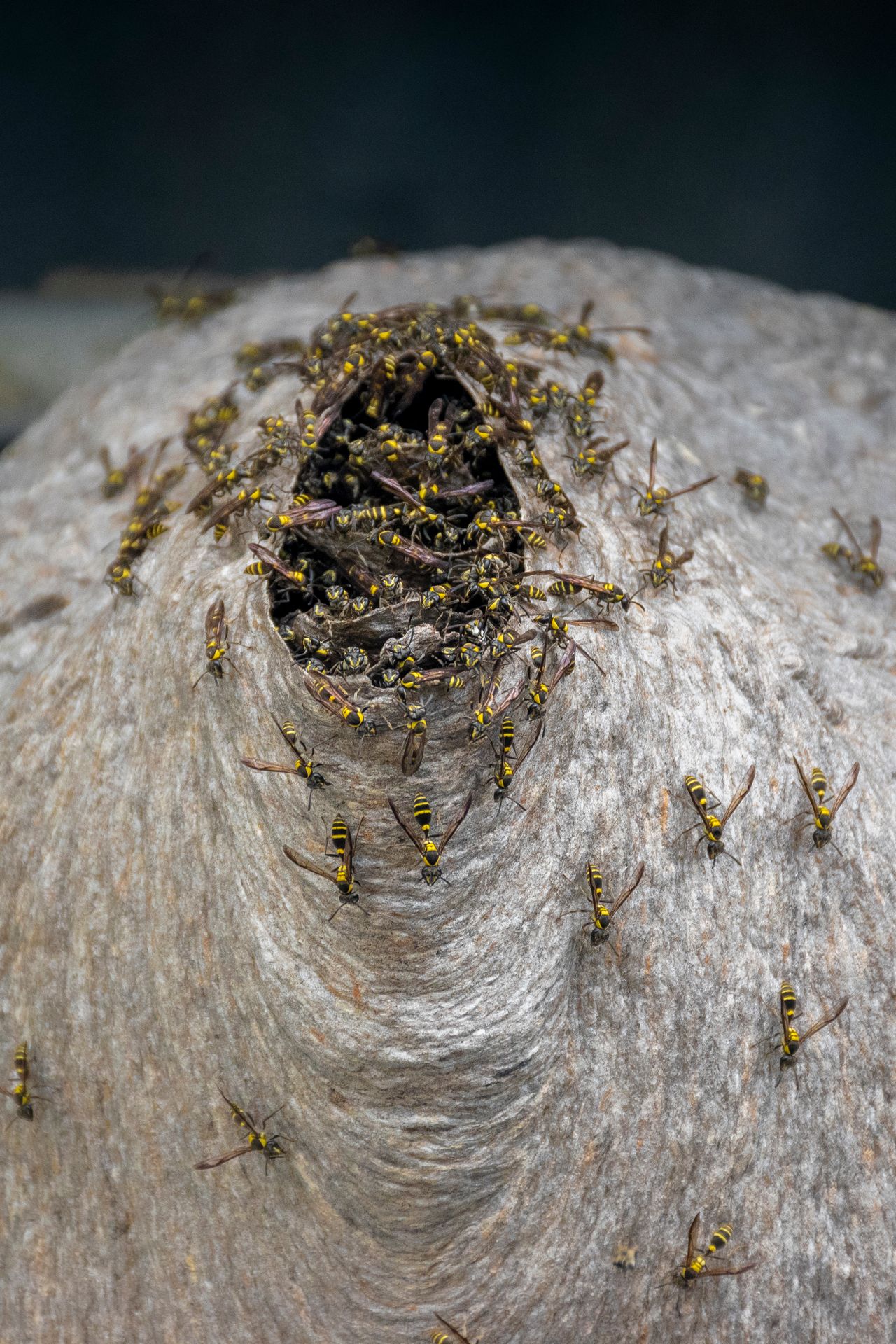
- A steady flight line at the eaves seen from the garden. Two minutes of watching one point on the roofline settles whether it is live; our guide on telling whether a nest is active walks through the count.
Why lofts suit wasps so well
A queen searching for a nest site in April wants three things: dry shelter, darkness, and peace. A roof void offers all three for months at a stretch, plus a ready supply of bare timber to strip for paper and a felt-and-rafter ceiling to anchor the nest to. Compared with a hedge or a hole in the ground, it is luxury.
The housing stock round here hands out invitations too. The Edwardian villas of Bowdon and The Devisdale carry slate roofs where a single slipped slate opens a corridor straight into the void. Timperley and Sale's 1930s semis have timber soffit boxes that shrink and part at the joints after decades of repainting. Even the newer estates off Sinderland Road tend to leak at the junction where an extension or dormer meets the original roof. None of this means anything is wrong with the house. A gap the width of a pencil is all a queen needs.
What not to do
- Never block the entrance hole. It feels logical and it is the worst available move. A sealed-in colony does not give up and die; several thousand workers start hunting for another exit, and the plasterboard over your landing offers far less resistance than you would hope. Trapped colonies are how wasps end up inside bedrooms.
- Never empty an aerosol at a nest in an enclosed loft. You would be in a cramped, dim space, breathing the spray, with the only exit behind you and an alarmed colony between you and it. Hospital visits follow from exactly this scenario every summer.
- Skip the expanding foam. It combines the sealed-hole problem with a surface wasps chew through anyway.
- Leave night-time investigation alone. Wasps do not sleep the way people imagine, and a torch beam at the nest brings defenders straight to it.
How professional treatment actually works
Almost every loft nest is treated from outside the house, at the point where the wasps enter. Working from a ladder at the eaves, we place a professional insecticidal dust into the opening. Every worker passing through the hole picks it up and ferries it deeper into the colony, where it reaches the brood and the queen within a day or two. The colony destroys itself through its own traffic, which is precisely why the method works on nests that cannot be seen or reached directly.
Your loft stays untouched: no boards up, no insulation moved, no crawling between joists, and in the normal run of things nobody enters the house at all. The dead nest stays where it is, dries to a brittle husk, and can be bagged up during a winter clear-out or left indefinitely. Since no colony ever moves into a used nest, removal is cosmetic rather than necessary.
The fee, and what backs it
A loft or roof nest costs £60, the same fixed figure we charge for any wasp or hornet nest in Altrincham and across Trafford. There is no call-out fee, no ladder surcharge, and no premium for evenings or weekends. The treatment carries a one-visit guarantee: in the rare case a colony is still flying a few days later, we come back and go again without charging. Ring 07770 015197 before mid-afternoon and the visit is usually same-day.
Hearing it above the ceiling?
£60 fixed, treated from outside, one-visit guarantee. Same-day across Altrincham and Trafford where possible.
Call to BookFrequently Asked Questions
Barely. Wasps rasp a thin surface layer from rafters and boards to make paper, which leaves faint pale scratch marks but no structural harm. Very large nests occasionally leave a brown stain on the plasterboard beneath them. The real risk in a loft is to people, not timber, which is why DIY treatment in that confined space is a bad idea.
No, and we would rather you did not. The treatment targets the entry point on the outside of the roof, so the exact position of the nest inside the void makes little difference. Tell us which room the noise sits over, or where you see wasps gathering on the roofline, and we take it from there.
The rustling fades noticeably within a day and is normally gone inside two to three. Odd stray wasps can appear at the entrance for up to a week in peak season, as workers that were out foraging return to a colony that no longer exists. Each one carries the treatment further in, so the stragglers are finishing the job.
The nest itself never will, because wasps do not reuse old nests under any circumstances. The gap the colony used is another matter, since next spring a different queen may like it for the same reasons. Once all activity has stopped, usually a week or two after treatment, having the gap sealed is worthwhile.