A wasp nest in a shed, garage or outbuilding is treated on the same visit, and for the same £60 fixed fee, as a nest on the house itself. The treatment takes a few minutes at the entry point. Keep the building shut for the rest of that day and it is normally usable again the following morning. You do not need to be able to see or reach the nest — most of them sit in the roof space or behind the cladding, and the work is done at the hole the wasps are using.
Why shed nests get left too long
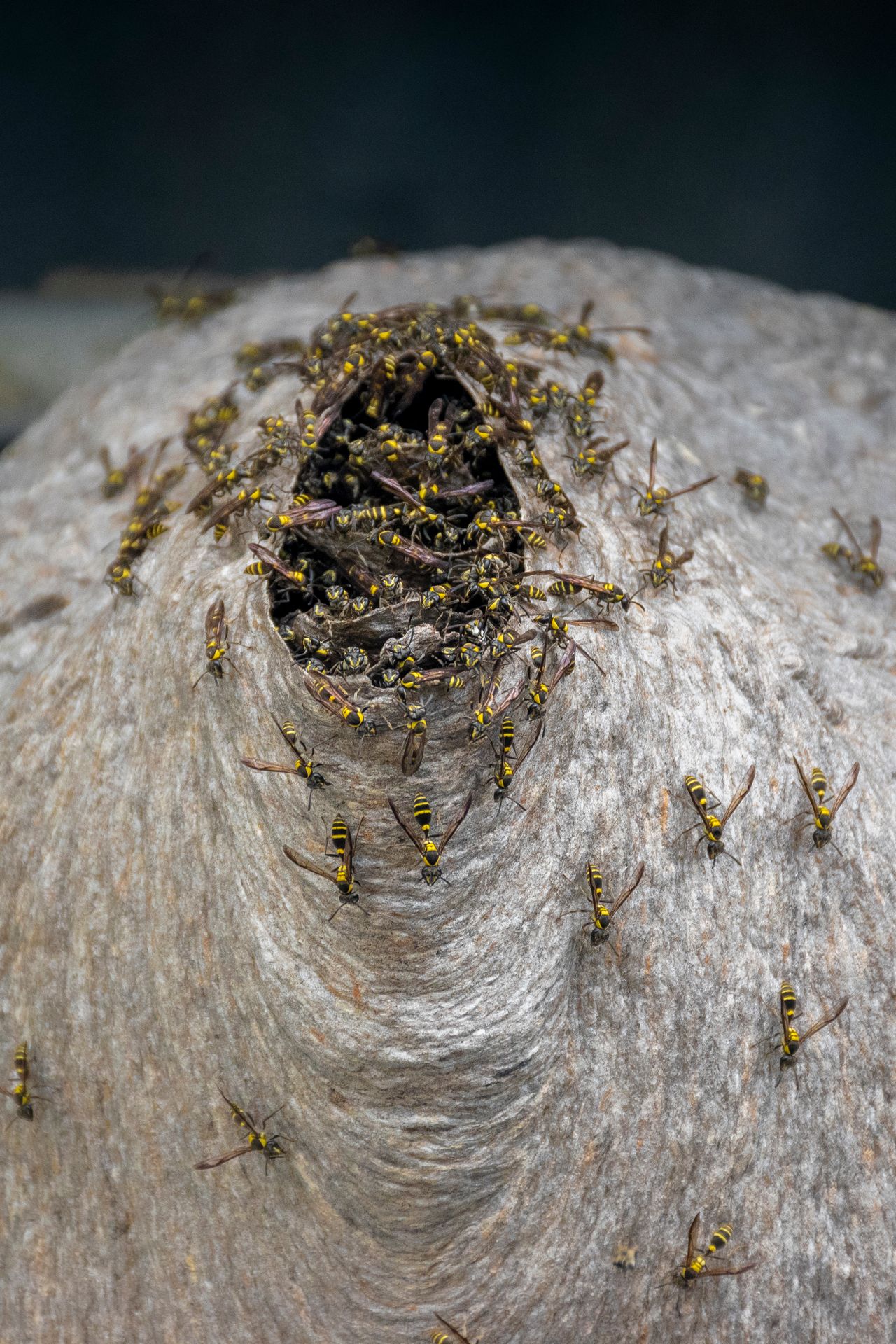
Almost every outbuilding call we take in August starts the same way. Someone noticed a few wasps going in and out in June, decided the shed was not the house, and shut the door on it. By the time they ring, the nest is the size of a football, there are several thousand workers in it, and the building has been out of use for a month.
It is an understandable decision and it is usually the wrong one. A nest in a garden building is not a smaller version of a loft nest. It is the same colony on the same timetable, with the difference that a shed has thin walls, one door, and nothing between you and the nest when you walk in.
Where wasps build in a timber shed
A shed gives a queen everything she is looking for in April: a dry cavity, no draught, no light, and a small entrance she can defend. The same handful of spots come up again and again.
- Under the ridge. The apex where the two roof slopes meet is the warmest, driest point in the building, and the nest hangs straight down from it — usually at head height.
- Behind the felt overhang. Where roofing felt laps over the roof edge and has lifted or lost a clout nail, there is a clean slot into the roof space. This is the single most common entry we see on sheds.
- Behind the fascia or barge board. The thin board along the gable edge often stands a few millimetres proud of the cladding, leaving a gap that runs the full length of the building.
- Under the floor, on a bearer. Sheds sitting on timber bearers or a couple of courses of brick have a shallow void underneath, and a nest built on the underside of the floor is heard long before it is seen.
- Inside stored boxes and furniture. Cardboard boxes, upturned pots, a rolled windbreak, a folded parasol, an old armchair — anything that has not been moved since last summer.
- In the channel behind the cladding. Overlap and shiplap boards leave a continuous gap behind them, and a colony can work its way several feet along it out of sight.
Garages, stables, log stores and brick outbuildings
On the larger plots around Knutsford, Mobberley, Dunham Massey and the lanes out towards Lymm, the building in question is often not a shed at all. Detached garages, brick stores, stables, tack rooms, summer houses and log stores are all common here, and every one of them offers a colony more room than a house does.
An unlit stable void is a particular favourite. Between the ceiling boards and the roof covering there is usually a deep, dark, undisturbed cavity, warmed through the afternoon, with a dozen ways in under the eaves — and directly below it, people and animals moving in and out twice a day. Log stores are the other one: stacked timber under a lean-to roof gives a colony a sheltered cavity nobody disturbs from May until the first cold week of October, which is exactly when someone reaches in for the first armful.
Hornets turn up in these buildings more often than in houses. A hornet is simply a large wasp — Vespa crabro — and it favours hollow trees and open outbuildings over roof voids. It is the same treatment at the same £60 fee. Hornets are generally less inclined to bother you than a common wasp despite the size, but a nest in a working stable or garage still needs dealing with.
The real hazard is the door
The reason we treat outbuilding nests as more urgent than their size suggests is the geometry of the building.
A nest under the ridge of a shed sits at head height, a metre or so from the door, in a room you cannot back out of quickly. When you open that door the light changes and the air moves, and the colony is alerted all at once. You are then in a confined space with one exit, and you are standing in it.
Add to that how these buildings get used. You go in carrying something. You are reaching above your head for a tool. You are dragging a mower out backwards. None of those leave you in a position to walk calmly away. Stings picked up in outbuildings tend to come in multiples rather than singly, and that is why.
Leaving it until autumn costs you the garden, not the shed
The advice you will read online is that the colony dies in autumn, so if you can avoid the nest you can simply wait it out. That is true as far as the shed goes. It is not true for the rest of the property, and this is the part nobody mentions.
Through July and August the workers are feeding grubs in the nest, and in return the larvae produce a sugary secretion the adults live on. In late August the queen stops laying. Within a couple of weeks there are no grubs left to feed, that food supply stops, and several thousand workers with a sugar habit and nothing to do are loose in your garden.
That is the September wasp everyone recognises: on the bin lid, in the glass, all over the fallen apples, wandering into the kitchen. They come from somewhere. If the somewhere is your shed, then the entire colony spends September within a few metres of your back door. Leaving a nest in an outbuilding does not really cost you the outbuilding. It costs you the garden, in the month you most want to be sitting in it.
The pale scoured lines on your cladding
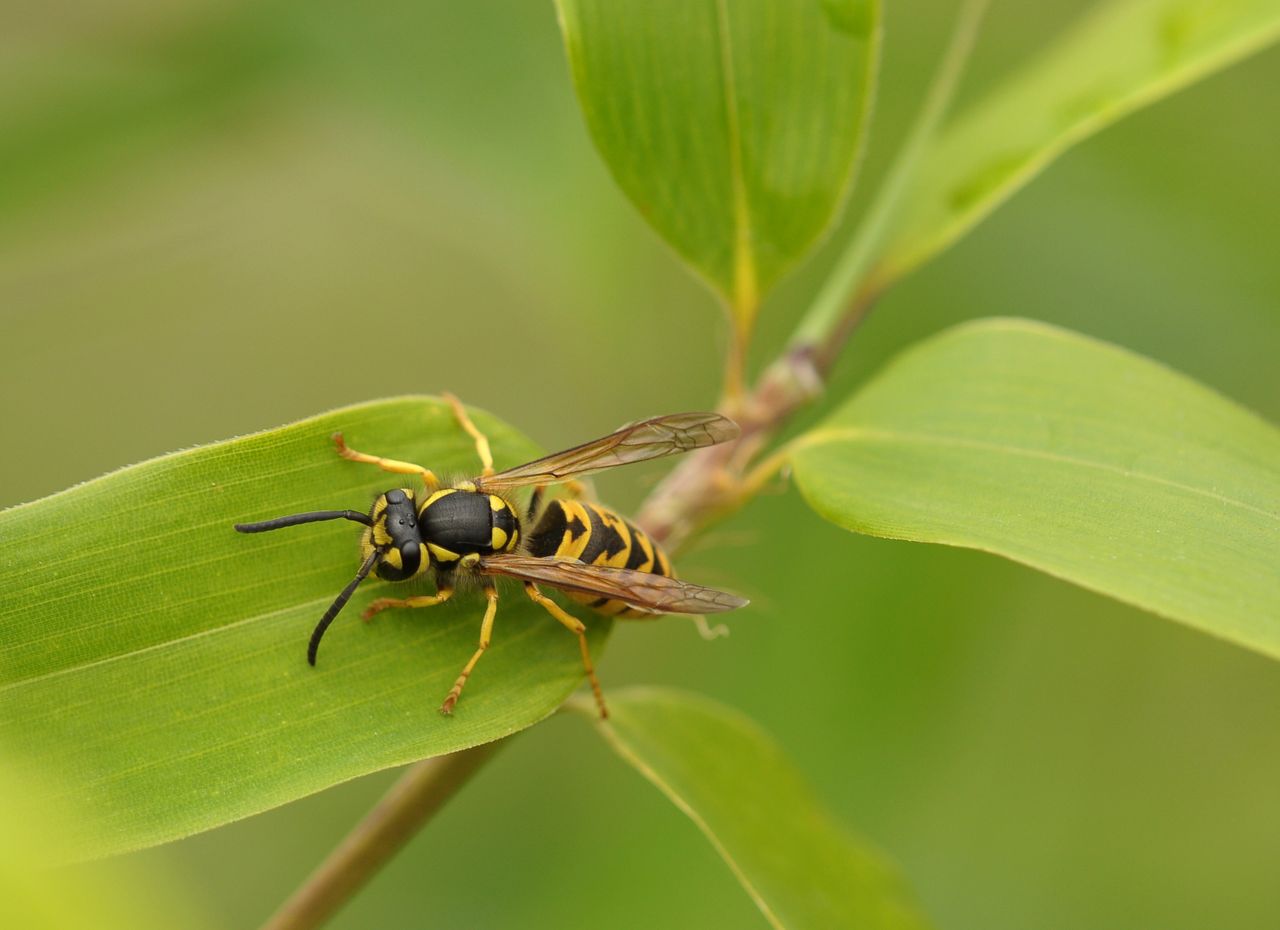
A fair number of people find the nest while looking for something else entirely. Wasps build with paper, and they make the paper by rasping wood fibre off weathered timber and chewing it into pulp.
On an untreated or sun-bleached shed, fence panel or gate, that shows up as pale scoured lines a few centimetres long running across the grain, slightly rougher to the touch than the wood around them. Stand close on a warm morning and you can hear the rasping. It does no meaningful damage, and on its own it is not a reason to treat — the timber could be feeding a nest fifty metres away in somebody else's garden. But scouring on the shed plus a steady flight of wasps under the felt is the nest found.
What to move before we arrive
- Animal feed and bedding. Bag it or shift it to another building. The same goes for bird seed and any open sack of anything edible.
- Food and drink. Garden bar stock, a drinks fridge, the box of squash by the door.
- Cushions, fabric and toys. Seat pads, a dog bed, a paddling pool, anything soft that gets handled a lot.
- Anything you will need before tomorrow. Only if you can reach it without going near the entry point. If you cannot, leave it where it is and say so when we arrive.
Everything else can stay put. The treatment is a targeted application at the nest entrance, not a spray or a fog through the building, so tools, timber and stored kit are unaffected. Afterwards, keep the door shut for the rest of the day. Foragers that were out when we treated will keep returning to the entrance for a day or two, which is how the treatment reaches the whole colony rather than just the wasps at home. Sweep the dead ones up a few days later with gloves on — a dead wasp's sting can still go into a finger if you press on it.
Do you take the nest away?
Usually not, and usually there is no need to. Once the colony is dead the nest is an empty paper shell. In a roof space, behind cladding or under a floor it is left in place, where it dries out and crumbles. It will not attract anything and it will not be reused.
Where a nest hangs in the open in a shed — off the ridge, on a beam, inside a box — you can take it down yourself two or three days after treatment, once all activity has stopped. Gloves, bin bag, straight in the bin. There is nothing alive in it.
The old nest you find in spring
Every March and April we get calls about a grey papery football found during a shed clear-out. If it is intact, dusty and silent, it is last year's and it is empty. Wasp nests are single-use: the colony died in autumn and next year's queens build somewhere new. You do not need us for that one. Take it down, bin it, and while the gap it was built behind is empty, seal it — that stops a new queen choosing the same spot in April.
Bumblebees in a shed or compost bin
Not everything that nests in an outbuilding is a wasp. Bumblebees regularly move into compost bins, bags of old compost, bird boxes fixed to a shed wall, and loft insulation in a summer house roof. They are large, furry, rounded and slow, with an audible low buzz, and there will be a few dozen of them rather than thousands.
In nearly every case the honest answer is to leave it alone. A bumblebee colony is short-lived — typically a matter of weeks from the point you first notice it — and it dies back on its own at the end of the season. The nest is never reused. If you can give it a wide berth until then, that is the whole problem solved and it costs you nothing. Where treatment is genuinely warranted, because the entrance is in a doorway you use every day or someone in the house reacts badly to stings, bumblebee treatment is £70 fixed. Our bumblebee page sets out when that is justified and when it is not.
One other thing worth knowing if you have opened a shed on a cluster of insects in early summer. Smaller, slimmer, matt amber-brown bees hanging together in a hanging clump are honeybees, most likely a swarm that has settled temporarily. That is not a wasp job and not a treatment job — a local beekeeper may collect a honeybee swarm.
If you are not certain what you have got, a description on the phone usually settles it in a minute. Ring 07770 015197. If it is something you can safely leave alone, we will tell you so.
Wasp nest in a shed or garage?
£60 fixed fee, same-day across Altrincham and Trafford. Outbuildings are the same price as the house, and you do not need to know exactly where the nest sits.
Call to BookFrequently Asked Questions
Wasp nest removal in a shed, garage or outbuilding costs £60, the same fixed fee as a nest on the house. The price does not change because the nest is in a garden building rather than the roof, and there is no call-out charge or weekend surcharge.
Normally the following day. Keep the building shut for the rest of the day after treatment, because returning foragers will still be arriving at the entrance for a day or two afterwards. Once activity at the entry point has stopped, the shed is fine to use as normal. Sweep up any dead wasps with gloves on.
Yes, and at the same price as a nest on the house. Detached garages, brick outbuildings, stables, tack rooms, log stores and summer houses are all treated on the same visit for £60. Hornet nests, which turn up in outbuildings far more often than in houses, are the same job at the same fee.
You can, but it usually costs you more than the use of the shed. The colony does die back in autumn, so a nest in a genuinely out-of-the-way building can be waited out. What people are not told is that in September the workers stop feeding grubs and start hunting sugar, which puts several thousand wasps around your bins, your fruit trees and your back door for a month.
They are collecting nest material. Wasps build with paper, made by rasping wood fibre off weathered timber and chewing it into pulp with saliva. It leaves pale scoured lines across the grain on untreated sheds, fences and gates. It does no real harm to the timber, and on its own it is not proof of a nest on your property.
The treatment kills the colony, and the nest is usually left where it is. An empty nest is a dry paper shell that will not be reused and attracts nothing. Where a shed nest hangs in the open on a beam or a roof sheet, you can take it down yourself two or three days after treatment, once activity has completely stopped.
No, and you do not need us for it. Wasp nests are single-use: the colony dies in autumn and next year's queens build somewhere new, so an intact, dusty, silent nest found in spring is empty. Take it down, bin it, and seal the gap it was built behind so a new queen has to look elsewhere.
In almost every case, nothing at all. A bumblebee colony in a shed or compost bin is short-lived, usually a matter of weeks from the point you first notice it, and it dies back naturally at the end of the season without ever being reused. Give it a wide berth and the problem ends on its own. If it genuinely cannot be left, treatment is £70 fixed.