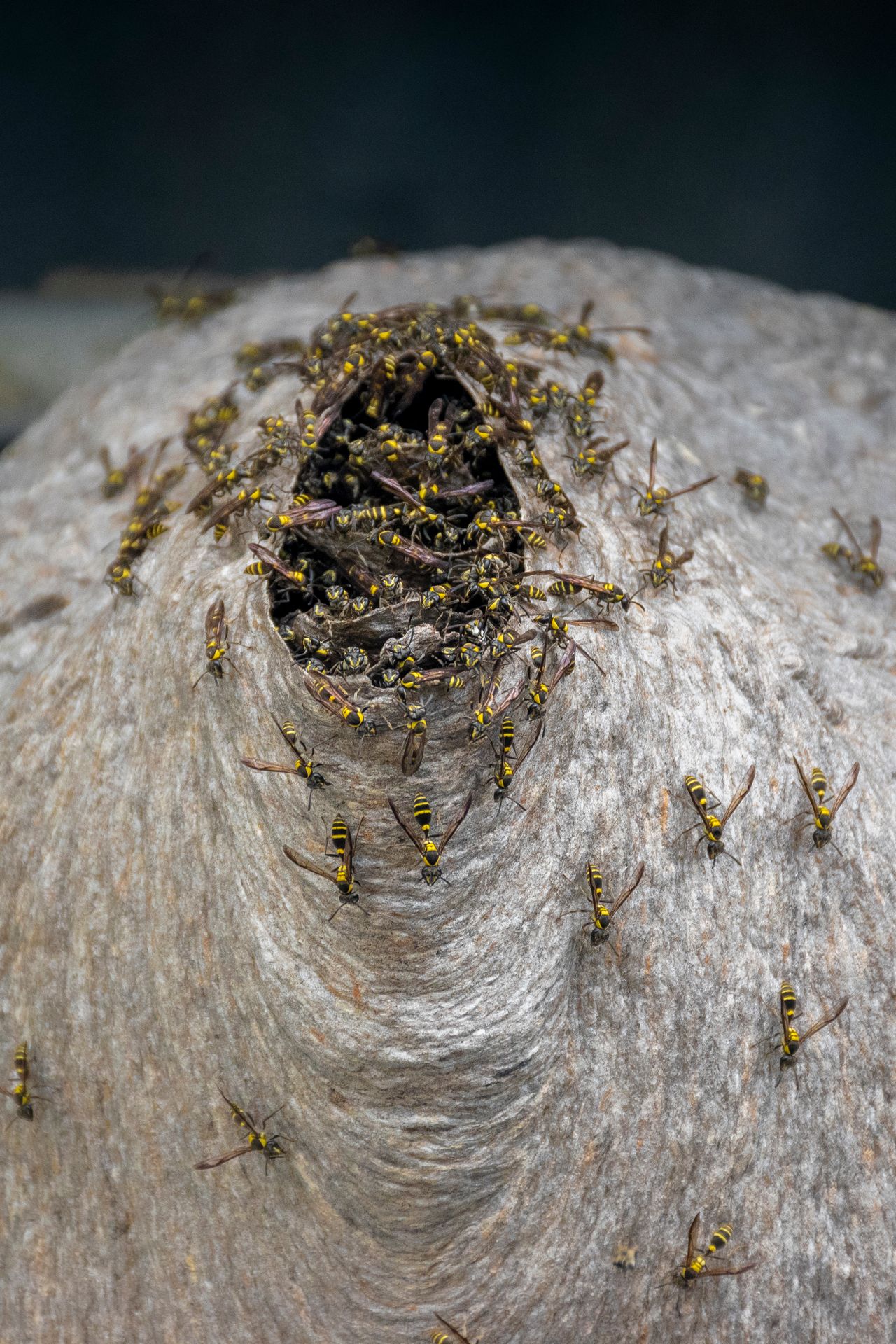
A wasp nest is active if wasps are moving in and out of one opening in a steady two-way stream during warm daylight. Give that hole two minutes of your full attention from a safe distance. Ten or more passes in that time confirms a live colony. No movement at all on a dry, warm afternoon means the nest is dead, empty or abandoned. In August, when colonies around Altrincham reach their peak, an active nest rarely leaves much room for doubt.
The two-minute entrance test
Find the opening first. It might be a gap under a roof tile, a slot where a soffit board has shrunk, a hole in shed cladding, or a burrow entrance in a lawn or border. Stand three or four metres back, out of the direct flight line, and fix your eyes on that single point without letting them wander. Then count every wasp that enters or leaves over two minutes.
- Ten or more passes: a live nest, no question. In high summer a busy colony can manage a wasp every three or four seconds.
- Three to nine passes: probably live, possibly a young or declining colony. Count again an hour later before deciding.
- One or two passes: likely foragers investigating, not residents. Wasps travel a few hundred metres from home, so a garden backing onto Stamford Park or the Bridgewater Canal embankment will always have some passing trade.
- Nothing at all: hold that verdict until you have repeated the count on a second warm day.
Behaviour matters as much as the number. Residents commit: they arrive on a straight line, land at the hole and walk straight in, then exit and climb away without hesitating. A wasp that drifts along the fascia, doubles back and loses interest is shopping, not commuting.
Morning against evening
Wasp traffic tracks temperature. On a summer morning the first workers leave once the sun has warmed the nest, and the flow builds steadily towards a peak in the early afternoon. Towards dusk the pattern reverses: departures dry up while foragers stream home, so an evening watch shows mostly inbound flights. By full dark the entrance goes still, even though thousands of wasps are awake inside.
The practical point is simple. A check at 7am or 9pm tells you very little, and a check in rain or a stiff wind tells you nothing. If your only free moment is early or late, treat a quiet entrance as unconfirmed rather than dead.
The sound check
For a nest inside a wall, soffit or loft, sound is the second instrument. Choose a still, warm evening, go to the room nearest the suspected spot, and listen with your ear close to the surface rather than pressed against it. A live colony produces a dry, continuous rustle, a bit like faint radio static, sometimes swelling briefly when something disturbs the workers. Total papery silence on a warm evening, checked twice, suggests the colony has gone. If the noise is above a bedroom ceiling, our guide to a wasp nest in a loft or roof covers what happens next.
Where the season comes into it
Timing shapes the answer before you even look. Queens found their nests in April and May, colonies grow quietly through June, and most people first notice traffic in July. By the middle of August a mature nest holds thousands of workers and defends itself readily, which is why this month produces more calls across WA14 and WA15 than the rest of the year combined. Any nest confirmed active now will stay active, and stay defensive, into October.
The calendar also works in reverse. A grey paper ball discovered while clearing a loft in January is last season's nest and contains nothing alive. Nobody needs to treat it.
Signs a nest is old or dead
- No entrance traffic across two separate warm, dry afternoons.
- Silence from inside the structure on a warm evening.
- Torn, bleached or collapsed paper, often with debris scattered below.
- Found between November and March, when no UK colony survives.
- Spiders' webs across the entrance hole, which no working colony would tolerate.
What to do in each case
A live nest near a door, a patio, a children's play area or a working garden should be dealt with, because colonies only grow larger and touchier as the weeks pass. A live nest in a far corner nobody visits, found in late September, can sometimes simply be left to collapse on its own; we will say so on the phone if that is the honest answer. A dead nest can be bagged and binned whenever convenient. If you cannot decide, send a short video of the entrance to 07770 015197 and we will read it for you.
When treatment is the right call, the job is one visit at £60 for a wasp or hornet nest, with no call-out fee and nothing extra for evenings or weekends. Same-day slots across Altrincham and Trafford are usually available if you ring before mid-afternoon, and if the colony is somehow still flying afterwards we return and treat again for nothing.
Counted the traffic and it's live?
£60 fixed for wasps and hornets, same-day across Altrincham and Trafford where possible. Call 07770 015197.
Call to BookFrequently Asked Questions
Watch the entrance for two full minutes in warm, dry daylight. Ten or more wasps passing in or out during that window confirms a live colony. Two or three passes could just be foragers from a nest elsewhere, so repeat the count later in the day before drawing a conclusion. Zero movement across two warm afternoons points strongly to a dead or abandoned nest.
Yes, in the wrong conditions. Wasps fly very little when it is cold, wet or windy, and a thriving colony can sit tight for hours in poor weather. Early mornings are quiet too, because the workers have not warmed up. Judge the nest only on a dry day between late morning and late afternoon, ideally above 15 degrees or so.
Never. Once the colony behind a nest has died, the paper structure is abandoned for good, and no future queen will take it over. What can happen is that the cavity itself attracts a fresh queen the following spring, because the dry, sheltered conditions that suited the first colony still exist. She will build a brand-new nest beside the old one rather than reoccupy it.
Most colonies around Altrincham collapse during October as the workers die off. A mild autumn stretches that: in a warm year the last stragglers can persist into early November. From December through to March any nest you find is a leftover, and by then it is safe to bag it up and bin it.