Yes, you can treat some wasp nests yourself, and it is not difficult. If the nest is small, outdoors, fully visible, below head height, and it is still early in the season, a proprietary insecticidal powder puffed at the entrance at dusk will usually finish it. If the nest is in a loft, a wall cavity, a soffit or the ground — or if it is August or later, wherever it is — leave it alone. This page covers both halves honestly, including why the home remedies the internet keeps recommending do not work.
Start here: the six-point check
Run through this before you buy anything. All six need to be true, not four or five.
- The nest is outdoors and you can see all of it. Hanging in an open shed, under a garage rafter, in a hedge at eye level, beneath a bench. If the wasps are vanishing into a hole and the nest itself is out of sight, it is inside a structure and this guide does not apply to you.
- It is small. Golf ball, tennis ball, at a push something the size of a large orange. If it is bigger than a grapefruit the colony is past the point where a single application of powder is a sensible plan.
- It is below head height and you can reach it standing flat on the ground. No ladder, no step stool, no upturned crate, no standing on a wall. This one is not negotiable and it is the rule most people break.
- You can be twenty metres away within three seconds. Clear ground behind you, no steps, no coiled hose, no gate that sticks, and a door you can actually get through.
- Nobody in the household reacts badly to stings. If anyone at the property has ever had a serious reaction to a sting, or carries an adrenaline pen, this is not a DIY job at any nest size. Small children and pets should also be indoors while you work.
- It is early in the season. May, June, or July at the outside. The reason for that cut-off is the next section, and it matters more than everything above it put together.
If all six are true, the job is genuinely straightforward and you do not need a pest controller for it. Go and buy a tin of powder and skip to the method below. A fair share of the people reading this page are in exactly that position, and we would rather say so than sell you a call-out you do not need.
Do not attempt it if any of this is true
- The nest is in a loft or roof void. You cannot control your footing, your exit, or the space you are working in, and disturbed wasps will follow you down the hatch.
- It is in a wall cavity, soffit, fascia, or under floorboards. You can only reach the entrance, not the nest, and you have no idea how large the colony behind it is.
- It is in the ground. Ground nests extend well beyond the visible hole and often have more than one exit. People get stung from behind doing these.
- It is above head height. A ladder removes your ability to leave quickly, and falls do far more damage than stings.
- It is within a couple of metres of a door, path, bin store, or a window you keep open. Even a successful treatment produces agitated wasps for a few minutes.
- It is August or later. Location stops mattering. See below.
- The insects are large, very furry, and slow. That is a bumblebee colony, not wasps. It almost never needs treating at all — see our identification guide.
- You are looking at a dense cluster of honeybees on a branch or a wall. That is a swarm, not a nest, and a local beekeeper may be willing to collect it. Leave it be and make a phone call.
The whole argument is colony size
A wasp nest is not a fixed object you are dealing with. It is a population curve, and where you are on that curve decides everything.
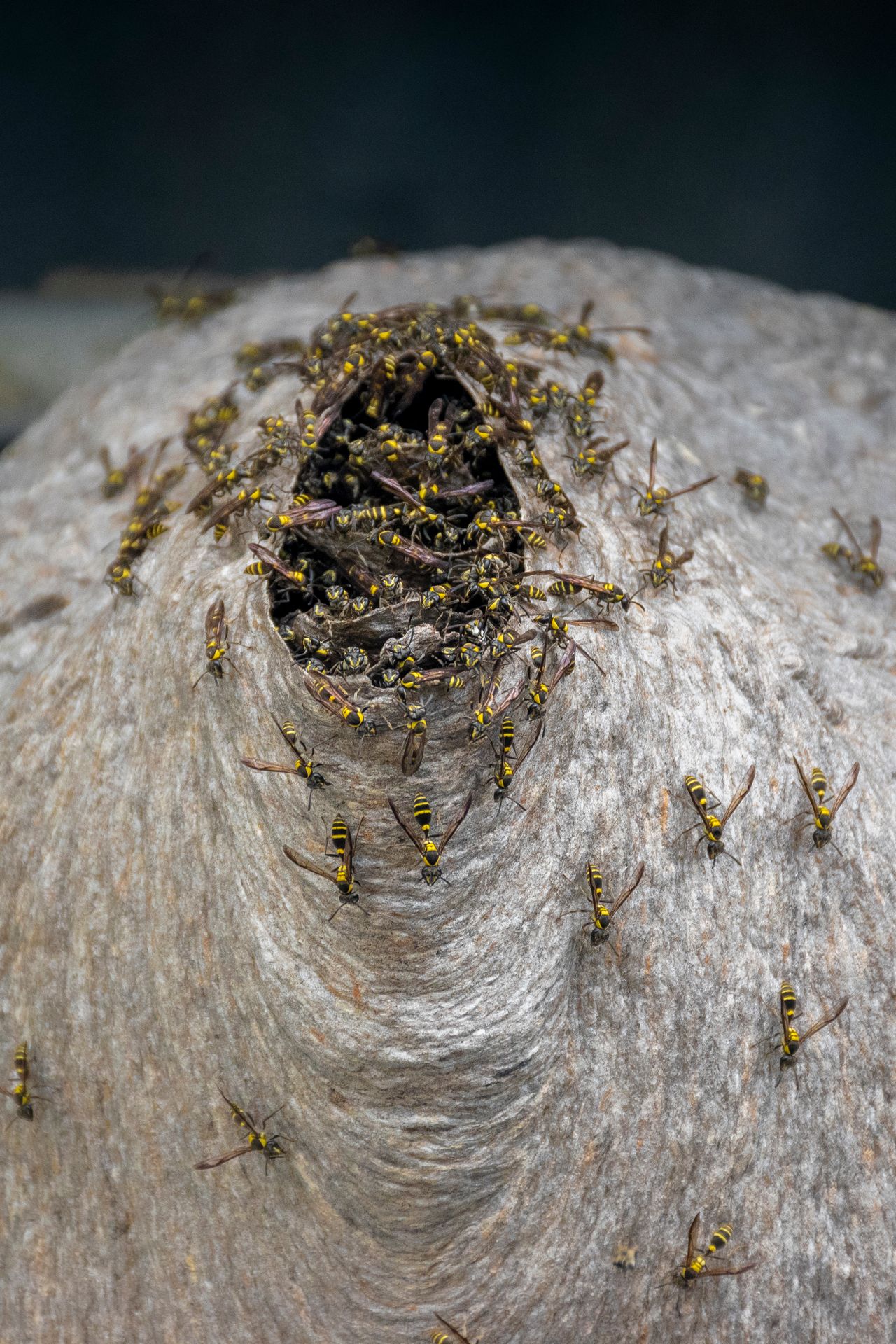
In late April a nest is one queen and a paper cone the size of a walnut. Through May and into June the first workers hatch and the colony is still only a few dozen strong — a number you could count. By late August the same nest holds several thousand adult wasps; the British Pest Control Association describes mature summer nests reaching into the thousands of individuals. Nothing about the technique below changes between those two points. The number of wasps that can respond to it changes by roughly two orders of magnitude.
Temperament changes as well. From August the queen stops laying, the workers lose their job of hunting protein for larvae, and they switch to scavenging sugar. They are simultaneously more numerous, more directionless, and defending a far larger nest. The job that was a five-minute non-event in June is a genuinely dangerous evening in September.
What does not work, and why
Most of these are repeated because they look like they work for about thirty seconds. Here is what is actually happening in each case.
Does WD-40 kill wasps?
Not reliably, and it is not an approved insecticide. WD-40 is a water-displacing oil. Sprayed at a wasp it wets the wings, the insect drops, and it looks like a kill — which is exactly why the trick spread. A good number of those wasps dry off and fly again. More to the point, it does nothing whatsoever to the nest: the queen, the brood, and every wasp still inside are untouched, and you have now coated a structure made of dry chewed paper in a flammable oil. Using a product as a pesticide when it holds no approval for that use is not a legitimate use of it.
Washing-up liquid and water
This works on what you directly soak and on nothing else. The mechanism is real enough — the surfactant breaks the surface tension of the water so it penetrates the breathing pores along the insect's body, and a wasp that takes a thorough direct hit does die. But you have to hit each wasp individually, you have to properly soak it, and the solution leaves no residual effect at all. Poured into a nest entrance it kills whatever is in the first inch of the tunnel while the rest of the colony comes out to find out what happened. It is a reasonable way to deal with one wasp in a conservatory. It is not a nest treatment.
Boiling water
Boiling water never reaches the comb. It is usually suggested for ground nests, and it fails for a simple physical reason: a kettle of water cools as it travels and disperses through soil, while the comb sits in a chamber the water largely misses. Ground nests routinely extend a good distance past the entrance you can see, sometimes with a second way out behind you. Meanwhile you are standing over a colony you have just provoked, on uneven ground, holding two litres of boiling water — and if somebody has suggested this for a soffit nest, you are doing it up a ladder with your arms above your head. The scald is a far more likely outcome than the kill.
Petrol, paraffin, and setting fire to it
Don't. This is the method that puts houses in the local paper every summer. Nests are dry chewed paper, they are almost always attached to timber, and petrol vapour travels a long way before it finds an ignition source. Beyond the obvious fire risk, petrol carries no approval for use as a pesticide, and UK pesticide and biocide rules do not allow you to press an unapproved substance into service as one. There is no version of this that is a good idea.
Blocking up the entrance
Sealing a nest in turns an outdoor problem into an indoor one. Wasps chew — it is how they build. Denied the way they came in, a colony will work at plasterboard, loft insulation, a ceiling rose or the gap around a light fitting until it finds another way, and that way is often into the room below. Seal the hole afterwards, once flight activity has completely stopped, never before.
What actually works: powder at the entrance, at dusk
Why powder beats aerosol foam
A nest is not killed by whatever you can personally reach. It is killed by the wasps themselves. An insecticidal dust puffed around the entrance clings to the legs, body hair and wings of every wasp that walks through it, and they carry it inside — into the comb, onto the brood, onto the queen. That is a delivery system no spray can match, and it keeps working for days as foragers come and go.
Aerosol foams do have a place. They knock down what is in front of you, they let you stand a bit further back, and on a fully exposed nest hanging in the open they are effective. But anything with a tunnel or a cavity behind it defeats them: the foam coats the first few centimetres and stops. If you are treating an entrance rather than a nest body, use powder.
The method, step by step
- Buy an amateur-use wasp nest powder. Any hardware shop or garden centre carries one. Read the label properly and follow it, including the advice about keeping children and pets out of the treated area. Most come with a puffer bottle or a small lance.
- Wait for dusk — not full darkness. The foragers are home, activity has dropped right off, and you can still see what you are doing. Early morning is the second-best window.
- Dress for it properly. Long sleeves, long trousers tucked into socks, boots, gloves, a hood or hat and something across your face. A wasp will not sting through two loose layers easily, but it will find a bare wrist or an ankle gap without any trouble.
- Walk your exit route before you start. Decide which door you are going through and confirm it opens. Move the hose, the bikes, the bin. Do this while you are calm rather than while you are being chased.
- Both feet flat on the ground. No ladder, no chair, no bin lid, no wall. If you cannot do the job standing normally, you are not doing the job.
- Apply at the entrance, not at the nest body. Puff a generous dose around and just into the hole the wasps are using. If the nest is fully exposed with no tunnel, dust the whole underside and the entrance together.
- Then walk away. Do not stand and watch. Do not go back for a second look. Get inside and leave it.
- Leave it for 48 hours. Activity should fall sharply within a day. A few confused foragers on day two is normal. If there is still steady two-way traffic after two full days, the treatment did not reach the colony.
- Remove the nest only once activity has stopped completely. Then it is just paper. Knock it down, bag it, bin it. Nests are never reused, so an old one in a loft can be left indefinitely if it is easier.
Do not point a torch at the entrance
Wasps orient towards bright light in low-light conditions, and a white beam aimed at a nest entrance in the dark gives disturbed wasps a target to fly at — usually the hand holding it. If you need light, use a red-filtered torch, or set a light on the ground several metres to one side so it illuminates the area rather than the nest. Better still, treat at dusk and don't need one.
If it goes wrong
Get indoors, shut the door, and do not walk back past the nest. That is the whole plan, and rehearsing it beforehand is what makes it work.
- Walk, don't run and don't flail. Swatting releases more alarm pheromone and brings more wasps to you.
- Straight line to the nearest door. Not the door you came out of, if that means passing the nest again.
- Once inside, stay inside. A handful of wasps will follow you to the glass and give up within a few minutes.
- Leave your kit where it fell. The puffer bottle will still be on the lawn in the morning. Nothing out there is worth going back for.
- Do not attempt a second application that evening. The colony is now alert and you are now rattled. Neither improves the odds.
- Treat stings with basic first aid — see our sting first aid guide and NHS guidance below. Call 999 immediately for any difficulty breathing, swelling of the face or throat, dizziness, or a rapidly spreading rash.
When to stop and ring someone
There is no cleverness left in this decision. If the nest is in the roof, in a wall, in the ground, above head height, or beside a door you use — or if it is August or later, wherever it happens to be — DIY is simply the wrong tool for it. The same goes if you treated a nest two days ago and it is still busy, which usually means the colony was larger or deeper than it looked from outside. That is a normal outcome, not a reason to go back and try harder.
Treatment across Altrincham and Trafford is £60 fixed, with no call-out fee and a free return visit if the nest is not fully destroyed first time. What you are paying for is not really the chemical — it is cover, a lance that reaches a soffit from ground level, and someone who has already done the exit-route thinking before they arrive.
Nest out of reach, or past the point of DIY?
£60 fixed fee, same-day across Altrincham and Trafford. If it turns out you could sort it yourself, we will tell you that on the phone.
Call 07770 015197Frequently Asked Questions
Yes, if the nest is small, outdoors, fully visible, below head height, early in the season, and you can walk away from it in three seconds. An insecticidal wasp powder applied at the nest entrance at dusk will usually finish it. If the nest is in a loft, a cavity, a soffit or the ground, or it is August or later, don't attempt it.
Not reliably, and it is not approved for the job. WD-40 is a water-displacing oil that wets the wings of a wasp it hits directly, so the insect drops — but many dry off and fly again. It has no effect on the nest, the brood or the queen, and it leaves a flammable oil on a structure made of dry chewed paper.
No. Water cools as it travels and disperses through soil or cavity material, so it rarely reaches the comb where the brood and queen sit. Ground nests in particular extend well past the entrance you can see. You are also carrying two litres of boiling water while standing over a colony you have just provoked.
For a DIY job, an amateur-use insecticidal powder applied at the nest entrance. Powder sticks to the wasps walking through it and gets carried into the nest, which reaches the comb, the brood and the queen. Aerosol foams knock down what is in front of you but stop at the first few centimetres of any tunnel or cavity.
Dusk is the right time; full darkness with a torch is not. At dusk the foragers are home and activity has dropped, but there is still enough light to see. A white torch beam pointed at a nest entrance in the dark gives disturbed wasps something to fly straight at, which is usually your hand or your face.
Activity should drop sharply within 24 hours and stop within 48. A handful of returning foragers on day two is normal — they were out when you treated. If there is still a steady stream in and out after two full days, the treatment has not reached the colony and going back for a second attempt in daylight is a bad idea.
Not for pest reasons. A wasp nest is single-use — the colony dies in autumn and no queen ever returns to it. Once activity has completely stopped you can knock a small outdoor nest down and bin it if it bothers you. An old nest in a loft is empty, inert, and safe to leave or remove at your leisure.
Wasp nest treatment in Altrincham costs £60, fixed, with no call-out fee, and that includes a free return visit if the nest is not fully destroyed first time. Hornets are treated the same way for the same price. Bumblebee nests are a separate job and are often better left alone entirely.
Sources and further reading
- NHS — Insect bites and stings
- NHS — Anaphylaxis
- British Pest Control Association — pest advice on wasps and colony size
- HSE — Pesticides and approved use
General guidance for UK householders. Always read and follow the label on any insecticidal product you buy, and stop if the job looks bigger than you expected. For medical concerns after a sting, call NHS 111, or 999 in an emergency.